
Millennial vs Gen Z Ads: I Tested the Trend, and It Lost on Every Book
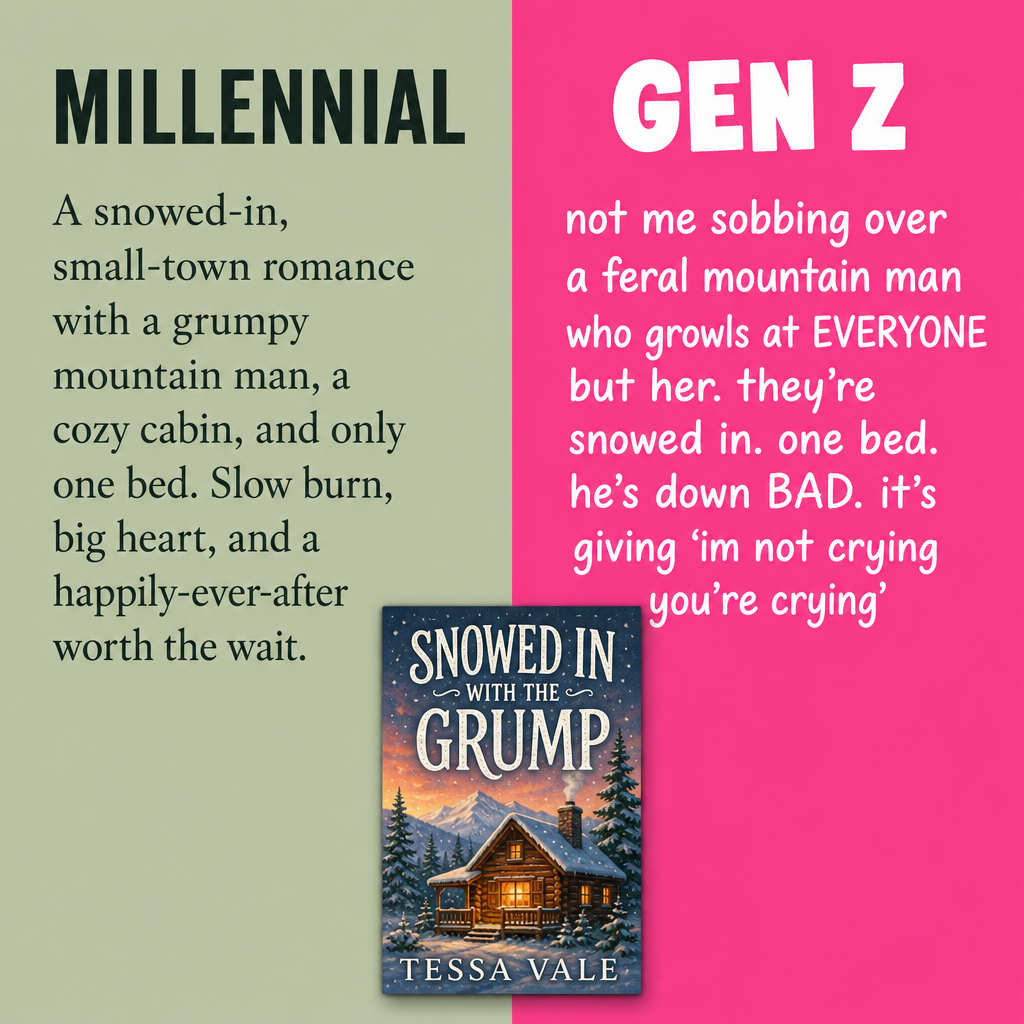
A while back I told you the "He's a 10 but…" format earned a spot in my rotation — real money, honest results, and it pulled its weight. So when the next meme format took over everyone's feed — "Millennial vs Gen Z," the polished marketing pitch on one side and the unhinged Gen Z reaction on the other ("bro is FERAL, it's giving one-bed energy") — I tested it the exact same way.
It lost. On every book I tried it on.
The Test
Same approach as last time: I ran Millennial vs Gen Z static ads across three different KU romance books — three authors, three subgenres — head-to-head against my other static creative (split-panels, cover ads, the rest). Then I compared Cost Per Unit: what it costs to generate one KU borrow or sale. Lower is better.
The Results
| Book | Millennial vs Gen Z CPU | Other Static CPU |
|---|---|---|
| Small Town Romance | $5.79 | $4.86 |
| Billionaire Romance | $13.06 | $9.59 |
| College Sports Romance | $11.99 | $4.68 |
CPU = cost per unit (KU borrows + sales); lower is better. Millennial vs Gen Z was more expensive per unit on all three books — and its clicks cost more too (higher CPC across the board).
Small Town Romance: $5.79 CPU vs $4.86 for the other static ads — about 19% more expensive per unit.
Billionaire Romance: $13.06 vs $9.59 — about 36% more expensive.
College Sports Romance: $11.99 vs $4.68 — more than double.
More expensive on all three. And the clicks themselves cost more — cost-per-click ran higher for the Millennial vs Gen Z ads on every book ($0.40 vs $0.31 on the billionaire title, for example). The format stops the scroll, but the people it pulls in click less, cost more, and convert into borrows and sales less efficiently than my normal creative.
An Honest Caveat
I ran some of these in their own smaller test campaigns, and my automated rules shut them off early for poor performance — so the sample sizes vary, and the sports book in particular got cut before it spent much. I'm not going to pretend the exact CPU on every book is gospel. But all three had enough clicks to be real data, and all three pointed the same way. When a format loses on three different books across three subgenres, that's a pattern, not a fluke.
The Takeaway
Millennial vs Gen Z is a great scroll-stopper. It's funny, it's shareable, and it has a real place — as organic content on your page or a TikTok, where engagement is the goal.
As a paid ad pointed at selling books? It cost me more per unit than my normal creative on every single book I tested. I'm not running it as a paid creative going forward.
This is the other half of the He's-a-10 lesson. I test the trends with real budget so the answer isn't "it feels like it should work" — it's "here's what actually happened." Sometimes the hyped format earns its slot. Sometimes it just quietly costs you more. The only way to know which is which is to test it.
Note: This data is from KU romance novels running Traffic campaigns on Facebook to US-based, women-only audiences aged 21-65+. CPU = cost per unit (KU borrows + sales). Your results may vary depending on your genre, audience, and creative.